Tuesday, September 24, 2013

Rereading the Tide Tables at Gettysburg

The "High Water" mark of the Confederacy has crept into and has remained as part of the historiography of the Battle of Gettysburg ever since "Colonel"  John B. Bachelder experienced an awakening as he strolled The Angle area of the Union line on Cemetery Ridge during the 1880s.  As Superintendent of Tablets and Legends for the Gettysburg Battlefield Memorial Association, he supposedly coined that phrase to describe the ineffective Confederate  breakthrough near a thicket of trees.

This point may well reflect the greatest point of incursion into the Union defenses by the Pickett-Pettigrew-Trimble charge during the third day of battle.  Is the high water mark label accurate when one views the entire campaign?  Geographically speaking the stain of the high water mark was left behind in Cumberland and York Counties which represents the furthest points north and east attained by the Army of Northern Virginia (ANV).

The second foray into the North by Confederate General Robert E. Lee became known as the Gettysburg Campaign which many historians say began on June 3 and ended on July 14, 1863.  The label Gettysburg is used because the largest land battle in North America occurred in the borough of Gettysburg and surrounding area during the campaign.  June 3 represents the date the ANV starting moving north and July 14 is the date the ANV crossed the Potomac River in retreat from its sortie.

Lee had several reasons for venturing north which included relieving Virginia of constant warfare, gathering supplies such as livestock, feed and food from the northern states as yet untouched by war, to engender support from the northern antiwar faction called Copperheads and of course destroy as much of the Union Army of the Potomac as possible.

To alert and panic the northerners Lee determined his focus would be on wreaking havoc in the north by menacing cities such as Harrisburg, Philadelphia and Baltimore.  He wanted to frighten the politicians in Washington to a degree that with adequate public pressure, the federal government would sue for peace.

Plaque on the Governor Curtin statue in Harrisburg
Lee's brilliant plan of hiding the ANV from Union troops by riding them north, west of the Blue Ridge worked perfectly.  The geography of the area reveals that the Shenandoah Valley in Virginia continues north as the Cumberland Valley of Pennsylvania and the South Mountain chain is an extension of the Blue Ridge.  The city which appears as a bulls eye to the Cumberland Valley arrow is Harrisburg, then and now, the capital of Pennsylvania.


State historical marker in Harrisburg.
Harrisburg was a major transportation hub.  The transportation of troops and commercial goods were serviced from points north and east by the Northern Central and Pennsylvania Railroads.  Camp Curtin one of the largest training camps and supplier of troops was located just north of the city.  In addition, historians also maintain that there were a fair number of Copperheads in central Pennsylvania during this period

General Richard Ewell commanding the Second Corps of the ANV was the lead element of the ANV which crossed the Potomac River on June 15.  On that same day orders were sent to Ewell from General Lee concerning his mission in Pennsylvania which included the following,  "If Harrisburg comes within your means, capture it."


On June 25 in Chambersburg, General Ewell met with General Early, one of his division commanders. General Ewell ordered General Early to cross South Mountain and go through Gettysburg.  He was then to proceed to York and cut the Northern Central Railroad which ran from Baltimore to Harrisburg.  Early was also ordered to destroy the Columbia-Wrightsville Bridge which carried track from York to the Pennsylvania Railroad at Columbia. 

On June 26 Early's column easily traversed Adams County, staving off some militia units and while in Gettysburg he garnered some supplies and rations.  Part of Early's column commanded by General Gordon took York on the 28th without opposition.  Early had ordered Colonel White's battalion of cavalry to ride to Hanover Junction and destroy as much track and bridges he could of the Northern Central.

Upon Gordon's arrival at the Wrightsville Bridge he found it was defended by 1,200 militiamen.  Shortly after Gordon attacked the defended portion of the bridge, the militiamen began retreating across the bridge.  The defenders outran the Confederates and fired the bridge in the process.   The bridge was totally destroyed and it actually ignited several buildings in Wrightsville.  The Southerners quickly transformed themselves into firemen and assisted the locals in quenching the flames.

With the bridge burned and unusable, Gordon and his men remained on the west bank of the Susquehanna River. Harrisburg was safe, for now.
Jenkins monument in Mechanicsburg, PA.

General Ewell continued north up the Cumberland Valley with his other infantry divisions commanded by Generals Rodes and Johnson and a brigade of cavalry lead by General Jenkins.  Jenkins brigade was in the lead and it was his duty to perform reconnaissance for the infantry corps.

Most of the Union troops Ewell encountered in Pennsylvania were not from regular army units.  These troops mustered to defend against the invasion into the state were militia and
emergency troops from Pennsylvania, national guard units from New York State and even some troops from New Jersey.  Locally recruited colored troops were used as well.

After easily brushing off some skirmishers at Stones Tavern in Cumberland County, Jenkins occupied Carlisle, the county seat and location of the U. S. Army's Carlisle barracks.  The handful of Union defenders wisely retreated north rather than take on the 1,200 troopers of Jenkins' brigade.  

Ewell's infantry arrived in Carlisle later in the day and several confederate officers felt at home.  Both General Ewell and General Iverson had once been posted at the barracks prior to the war, while they were in the U. S. Army.
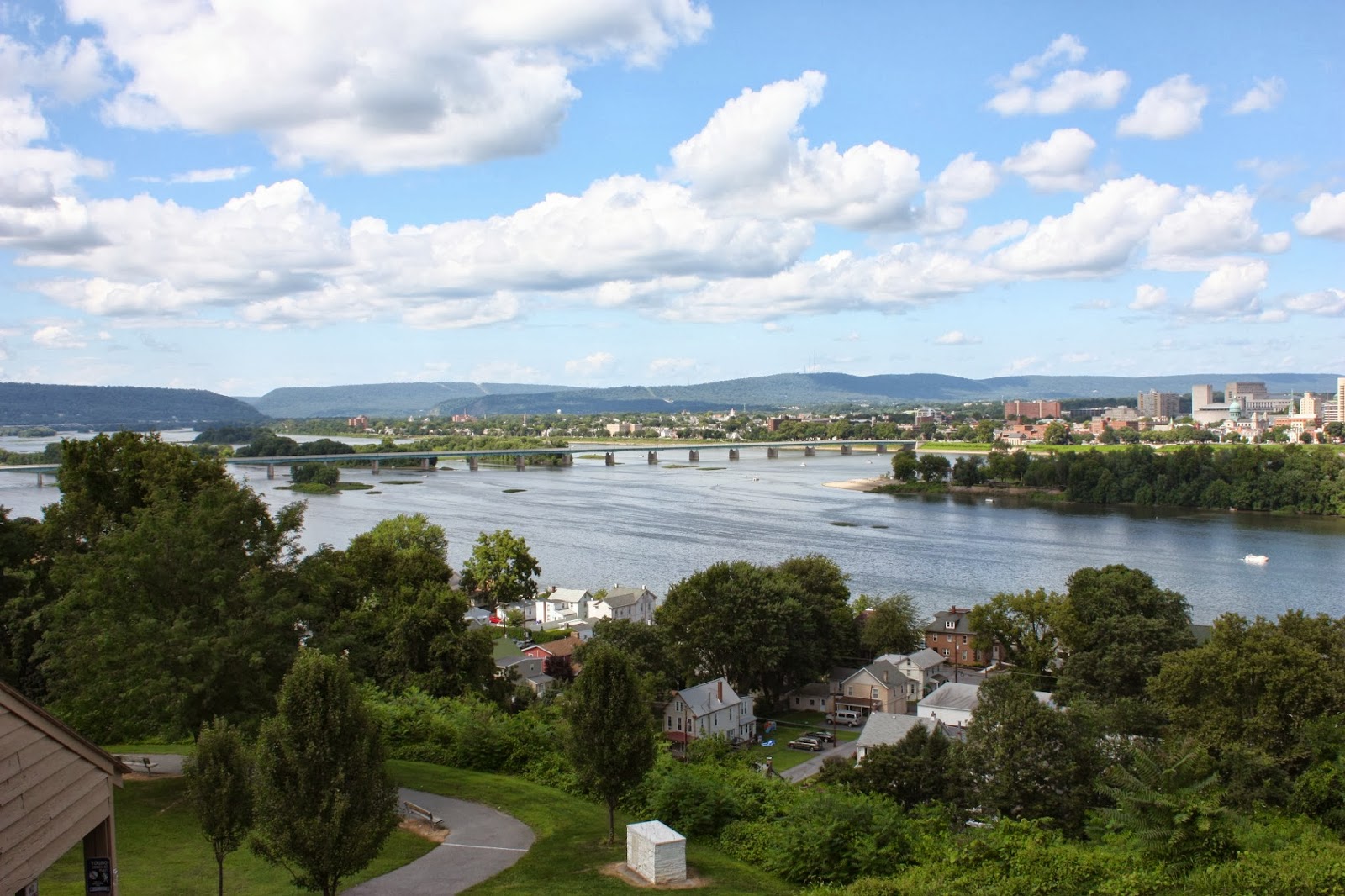
View of Harrisburg from the site of Fort Washington.

Ewell decided to remain at Carlisle while he sent Jenkins' cavalry and his engineering officer forward to reconnoiter the defenses of Harrisburg. 

On June 28 Jenkins made contact with the enemy at a location in present day Camp Hill known as Oyster Point where the Oyster family ran a
tavern. (It is the present day intersection of Market and 30th Streets.  The skirmish consisted of an exchange of  artillery and musket fire which was desultory in nature and lasted for a day.  The position was never taken since Jenkins used his time to scout the area.  He covered about a four mile front from Oyster Point to Slate Hill.
Monument at Lemoyne, PA.


Historical marker for Fort Couch, Lemoyne, PA.
Oyster Point was located two miles southwest of the Susquehanna River and situated near two newly constructed defensive fortifications called Fort Washington and Fort Couch, built across the river from Harrisburg.                                                              
Remnants of Fort Couch.

On June 29 Ewell's division began moving back south by an order of General Lee.  The main body of the Union army was located in the vicinity of a small town called Gettysburg.


Sunday, March 31, 2013

The Bonds of War


Sainte-Mere-Eglise is one of four sister cities of Gettysburg, Pennsylvania.  What connection does a small village in the Normandy region of France have with a small town in south central Pennsylvania?  The answer of course is, history.

In June of 1992, a letter from Mayor Marc LeFevre of Sainte-Mere-Eglise was presented to Mayor Francis Linn of Gettysburg, which suggested that the two towns should form that relationship.  LeFevre explained that both communities were important in the history of their countries. 

Gettysburg was famous for a pivotal battle of the American Civil War and Sainte-Mere-Eglise was the first French city to be liberated by Allied troops as a result of the D-Day Invasion of Normandy.  He cited that General Dwight Eisenhower's nexus to both in that President Eisenhower chose to purchase a home in Gettysburg and that he was also the Supreme Allied Commander of the Allied Forces which liberated his town.  It was also mentioned that the Marquis de La Fayette assisted the U. S. in the American Revolution and two hundred years later, "...your soldiers willingly came to France to restore our lost dignity and freedom."

In a poignant portion of the letter LeFevre stated, "Thirteen thousand young American soldiers were buried here in three temporary cemeteries..."  He further added that those bodies which weren't repatriated were buried,  "...at the Normandy American Cemetery and Memorial located at Colleville sur Mer overlooking Omaha Beach."

The offer was enthusiastically accepted by Gettysburg officials and during the intervening years delegations from both cities have visited each other.  A warm, friendly and respectful relationship has been achieved between both communities.  It was reported that during the trip to Normandy for the Fiftieth Anniversary of D-Day, the Gettysburg delegation received emotional greetings of welcome and thank you from the locals residents where ever they traveled.  The French have not forgotten the American sacrifices suffered in the liberation of their country.

Few people realize that the bond between Sainte-Mere-Eglise and Gettysburg began to strengthen shortly after World War II, during the repatriation of American war dead of which Mayor LeFevre spoke.  The strength of that bond comes from the fact that many of these dead came to their final rest in the Gettysburg National Cemetery.  Recent scholarship has showed that at least twelve of those American heroes who died on June 6, 1944, on and near the beaches at Normandy were re-interred in Gettysburg.

One of those soldiers was Private First Class Clairus L. Riggs of Company B, First Battalion, One Hundred Sixteenth Infantry of the Twenty-Ninth Infantry Division.   He was from Coalport, Clearfield County, Pennsylvania.

In the early morning hours of June 6, 1944, PFC Riggs was being transported across the English Channel aboard the troop transport S.S. Empire Javelin.  At 0330 hours, the landing craft containing Boat Team One of Company B was heading toward Omaha Beach.  Riggs carried a Browning Automatic Rifle which is a light machine gun that was deployed in a squad of men.  At 0640 hours the ramp of the landing craft was lowered in the surf off of Dog Green Sector.  As the six foot two inch soldier stepped on the ramp he was hit by enemy gunfire and fell into the water, dead. 

Clairus made it back to the United States and rests in Gettysburg National Cemetery, section 2, grave number 308.


Tuesday, March 26, 2013

Lincoln, the Movie


I have just finished watching Lincoln for the first time on a newly purchased DVD.  My opinionated review follows:

HISTORICAL WORTH OF THE FILM - B+  The film dealt with the battle fought to attain passage of the Thirteen Amendment to the Constitution of the United States.  I have not completely researched every aspect of the historical content as some have done but in general the matter was treated within the general notions of Nineteenth Century United States.  This episode in the Lincoln saga is only one small aspect of his historical impact but it was done well and treated appropriately within the time constraints of the movie.

QUALITY OF ACTING - C+  Daniel Day Lewis is not a favorite of mine.  I have seen him in several performances on the screen and none have impressed me.  His portrayal of a conflicted genius such as Abraham Lincoln was flat and stale.  The dialogue used seemed to be an endless series of closely cropped speeches given with no particular dramatic impact.  Of recent portrayals of Lincoln the best which comes to mind is that of Sam Waterston's in Gore Vidal's Lincoln done for television years ago.  Tommy Lee Jones role as Thaddeus Stevens was much more impressive than Lewis' Lincoln.

CINEMATOGRAPHY - C-  The mostly dark and dank scenes depicted throughout the movie were boring, lifeless, non-dramatic and inaccurate.  I get it.  In a four year span over 600,000 Americans died of battle wounds and disease.  It was indeed a bleak time in our nation's history.  Reality dictates that these events happen on overcast, cold, wet and bleak days as well as those that were sunny, fair and bright.  I remember a day in which over 3,000 people were murdered in three states and that September 11 was a crisp, clear sunny day with azure blue skies with wispy clouds.

OVERALL SUMMARY-  C+ To its credit the film accurately portrayed a time in our history where a controversial topic of the day was fated.  No movie is ever 100 percent historically accurate but good enough for general education of a public that does not read books but drowns itself in an electronic cloud of social websites and inane television programs.  There is room for at least 20 more movies of this quality, to begin to attempt to explain Lincoln and the American Civil War.  My advice for you all, if you have not yet done so, is to read Team of Rivals by Doris Kearns Goodwin.  Quite honestly, I'll be hard pressed to view Spielberg's Lincoln a second time.

Saturday, December 1, 2012

A Hangover


Right now I am suffering from a hangover.  No, not the usual kind you think of but one I have experienced three times before.
  
The befuddled and lightheaded fog is due to the fact that my brain cannot take anymore review of miniscule facts and picayune information.  Today was my fourth effort in taking the examination for Licensed Battlefield Guide at Gettysburg. 

It is difficult for me to predict how I fared so it will be easier to await the letter from the ranger in charge of the program.


My first foray into the examination process was in 2006 when I scored 77%.  It was obviously too low to qualify but not bad for a candidate living 475 miles away.

I retired in 2007 and moved to Adams County,  to a location in the suburbs of Cashtown.  The Gettysburg National Military Park was the wife-approved mistress that wooed me to the area.  It was a fulfillment of a pipe-dream that was ten years in the making.

Once I settled in, I started taking all the tours of the battlefield I could, including the Guide Series that was offered by the Harrisburg Area Community College.  I got involved in a study group and then took the exam in 2008.  I then scored a 90%, but still I missed the cut for the orals.

In 2010, I dropped the study group because of a full time job and eventually scored a 95%.  I still missed the cut.  I also quit the full time job when I realized why I had retired in the first time.

For today's exam I approached the test in a earnest but relaxed manner as opposed to the frenetic pace of the past.  I was not nervous or agitated as I calmly opened the test packet.  While I answered the questions I realized that I actually enjoyed taking the test!  I did not care whether I scored well or not, I really did enjoy the process.

The most satisfying moments of the morning were spent in conversations with like minded people who were seeking that coveted position of Battlefield Guide.  It is a position of honor and respect awarded to a few individuals that can with historical accuracy and deep appreciation, tell the story of the Battle of Gettysburg. 
Personally, I was greatly honored to be greeted with warm respects and well wishes by no less than ten Licensed Battlefield Guides that I have come to know in the last few years.

Regardless of the results of this 2012 exam, I believe I have accomplished a great deal in the past few years.

I still marvel at the fact that the battlefield is only minutes away as opposed to hours.  I have several history projects going on that I hope will lead to publication.  I have made friends with many people who understand and respect the study of the past.  I am glad I made the decision to move here and I feel honored that someday I may have the opportunity to guide others on America's most hallowed ground.


I feel better now.  My head is clearer and the little nap did me good.  Now...., where is that scotch?!

Tuesday, November 27, 2012

Your Own Time Machine


One interesting and easy way to explore history is to peruse issues of old newspapers.  This can be accomplished by visiting your local library, the Adams County Historical Society or at home by browsing the worldwide web.

In this inquiry I chose the November 16, 1918 issue of the Gettysburg Compiler to examine.  The major headline that day was "GERMANY SURRENDERS" which reports the terms of the Armistice which notably took effect on the eleventh hour of the eleventh day of the eleventh month of 1918.  November 11 became the national holiday of Armistice Day but it eventually evolved into Veteran's Day which now celebrates the contributions of all military veterans, living or dead, for any service. 

The second place story was the continuing death toll of the Great Influenza Epidemic of 1918.  The paper listed twenty three deaths for the week in the general population, the vast majority of which were due to the flu and Camp Colt reported six soldiers succumbed to the deadly virus.  It was interesting to note that two of the civilian dead included two veterans of the Civil War reminding us that in 1918, the war was still a recent memory for many Americans.

A small notice told of the death of Colonel Robert Bruce Ricketts, seventy-nine years old of Lake Ganoga, Pennsylvania.  Ricketts had commanded the First Pennsylvania Light Artillery on East Cemetery Hill during the Battle of Gettysburg fifty-five years earlier. 

An advertisement relating to the flu epidemic was sponsored by The Vick Chemical Company of Greensboro, North Carolina.  The firm manufactured Vick's Vapo-Rub and the ad warned pharmacists to only order small batches of their product.  The supplies of the concoction were severely depleted due to the epidemic.  They insisted small batch orders would be filled and therefore more product would be available to more customers.

An intriguing ad by G. W. Weaver and Son of Gettysburg was found and its message was to buy union suits made by Munsingwear.  The cartoon in the ad depicts several doughboys clad only in union suits and campaign hats carrying bayoneted rifles as they advanced toward the enemy.  The caption below the sketch read, "The Battle Cry of Free "Em".  Further on, it was written, "In War Time as in Peace "the Munsingwear Line Holds."  Indeed.

An interesting border was given to that ad and two others that appeared in the newspaper that day.  The borders consisted of the repeating pattern of swastikas.  Through the centuries the swastika has been featured in many cultures in art, architecture and print.  It was a sign which meant to be good or of being higher of self.  In general usage, it was a symbol of good luck.

In 1918, the swastika symbol was used as a good luck symbol for the American troops sent overseas.  It was used in print associated with their heath and well being as well as being emblazoned across the American Bald Eagle on a good luck token.

The symbol became known as an emblem of shame and inhumanity because in 1920 the Nazi Party adopted it as their official party symbol. 

A short visit to yesteryear via old newspapers is interesting, entertaining and educational.  It also helps us to understand our past.  Enjoy!

Wednesday, November 21, 2012

Proclamation 5269


October 19, 1984

By the President of the United States of America

A Proclamation


Photograph courtesy of the United States Government
As we remember the faith and values that made America great, we should recall that our tradition of Thanksgiving is older than our Nation itself. Indeed, the native American Thanksgivings antedated those of the new Americans. In the words of the eloquent Seneca tradition of the Iroquois, ``. . . give it your thought, that with one mind we may now give thanks to Him our Creator.''

From the first Pilgrim observance in 1621, to the nine years before and during the American Revolution when the Continental Congress declared days of Fast and Prayer and days of Thanksgiving, we have turned to Almighty God to express our gratitude for the bounty and good fortune we enjoy as individuals and as a nation. America truly has been blessed.

This year we can be especially thankful that real gratitude to God is inscribed, not in proclamations of government, but in the hearts of all our people who come from every race, culture, and creed on the face of the Earth. And as we pause to give thanks for our many gifts, let us be tempered by humility and by compassion for those in need, and let us reaffirm through prayer and action our determination to share our bounty with those less fortunate.

Now, Therefore, I, Ronald Reagan, President of the United States of America, in the spirit and tradition of the Iroquois, the Pilgrims, the Continental Congress, and past Presidents, do hereby proclaim Thursday, November 22, 1984, as a day of National Thanksgiving. I call upon every citizen of this great Nation to gather together in homes and places of worship to celebrate, in the words of 1784, ``with grateful hearts . . . the mercies and praises of their all Bountiful Creator. . . .''

In Witness Whereof, I have hereunto set my hand this nineteenth day of October, in the year of our Lord nineteen hundred and eighty-four, and of the Independence of the United States of America the two hundred and ninth.

Ronald Reagan

Tuesday, November 20, 2012

Proclamation 3036 - Thanksgiving Day, 1953


November 7, 1953

By the President of the United States of America

A Proclamation

Photograph courtesy of 

Executive Office of the President of the United States


As a nation much blessed, we feel impelled at harvest time to follow the tradition handed down by our Pilgrim Fathers of pausing from our labors for one day to render thanks to Almighty God for His bounties. Now that the year is drawing to a close, once again it is fitting that we incline our thoughts to His mercies and offer to Him our special prayers of gratitude.

For the courage and vision of our forebears who settled a wilderness and founded a Nation; for the "blessings of liberty" which the framers of our Constitution sought to secure for themselves and for their posterity, and which are so abundantly realized in our land today; for the unity of spirit which has made our country strong; and for the continuing faith under His guidance that has kept us a religious people with freedom of worship for all, we should kneel in humble thanksgiving.

Especially are we grateful this year for the truce in battle-weary Korea, which gives to anxious men and women throughout the world the hope that there may be an enduring peace:

Now, Therefore, I, Dwight D. Eisenhower, President of the United States of America, in consonance with the joint resolution of Congress approved December 26, 1941, do hereby call upon our people to observe Thursday, the twenty-sixth day of November, 1953, as a day of national thanksgiving. On that day let all of us, in accordance with our hallowed custom, forgather in our respective places of worship and bow before God in contrition for our sins, in suppliance for wisdom in our striving for a better world, and in gratitude for the manifold blessings He has bestowed upon us and upon our fellow men.

In Witness Whereof, I have hereunto set my hand and caused the seal of the United States to be affixed
DONE at the City of Washington this Seventh day of November in the year of our Lord nineteen hundred and fifty-three, and of the Independence of the United States of America the one hundred and seventy-eighth.

DWIGHT D. EISENHOWER

Friday, August 31, 2012

The Most Important Event in 1860


It occurred at Cooper Union, in New York City. It was Lincoln’s Cooper Union Speech. After the speech was reported he became a political personality with national leadership capabilities.

The speech was a piercing objective analysis of the subject of slavery and its status in law. Lincoln outlined the constitutional history of slavery and by addressing the institution head on he highlighted that it was the hottest political issue of the day.

Slavery by itself did not start the Civil War but it was by far the most powerful and main topic of concern of the southern plantation politicians. It’s inclusion in many of the ordinances of secession help to lend credence to this notion.

Lincoln essentially grabbed the bull by the horns in the Cooper Union speech and that eventually catapulted him into the Republican nomination and eventually the presidency. It also gave the hot headed and misguided southerners a reason for secession. Their mistake was they never thought the Unionists, north or south would go to war to save the country they cherished.

Once slavery was the decisive issue it had to be dealt with for a final solution. Lincoln brilliantly used his executive powers for emancipation (a military tactic that had been used for centuries) to his advantage. It was the snowball that rolled down the hill to become the biggest avalanche in American history. It lead to the Thirteenth, Fourteenth and Fifteenth Amendments which not only rocked the foundations of the American democracy but made slavery a bane of civilized governments on a worldwide basis.

The year 1860 was defined by a speech given by a lawyer from Illinois, in New York City on February 27, 1860. The country still trembles from its connotations.

Read Lincoln's Cooper Union Speech here.

Thursday, August 30, 2012

Adams County Aids the Continental Army


In response to the fighting between British troops and colonists at Lexington and Concord, on April 19, 1775, the Second Continental Congress placed the Massachusetts volunteers in their own service and selected George Washington to command them.  This action gave birth to the Continental Army.

Congress also authorized the raising of ten companies of riflemen, for one year's service as additional manpower.  Pennsylvania was expected to provide six companies of these troops but the commonwealth provided nine.  These companies became known as Colonel Thompson's Battalion of Riflemen.

This sign at 44 York Street in Gettysburg
 marks the location of Gettys' Tavern.


York County, which at that time included what is now Adams County,  was represented by Captain Michael Doudel's Company.  It was, "... enlisted principally at Samuel Getty's Tavern..."  This company provided at least forty (probably much more) men to the total of 849 men listed for the battalion.  Included in this company was Lt. Henry Miller of Fairfield (then Millerstown) and Private John Dother, of Marsh Creek.  Doudel's men (Company C) left York on July 1 and arrived at Cambridge, Massachusetts on July 25.

Upon their arrival they made a favorable impression to the local populous.  An army surgeon noted, "They are remarkably stout and hardy men; many of them exceeding six feet in height."  As to their prowess as marksmen he commented, "... their shot have frequently proved fatal to British officers and soldiers, who expose themselves to view, even at more than double the distance of common musket shot."

Within four days the company skirmished at Charlestown Neck and lost one man to capture.  The rigors of the march and combat may have contributed to Captain Doudel becoming ill.  It was so severe that he resigned and as a result, Henry Miller was promoted to captain. 

The men of Company C fought well but they received a reputation of being insubordinate and undisciplined.  When two companies were needed to leave Cambridge and join an expedition to invade Canada, Lieutenant Colonel Hand reported, "The General [presumably Washington] refused peremptorily to take the York company." 

In spite of this imperfection, their fighting and shooting skills keep them in good stead.   Company C and the entire battalion continued to do good service around Boston.  They exhibited tenacious fighting at Ploughed Hill and Lechmere's Point.  Their military proficiency did not go unnoticed by General Washington.

On January 1, 1776, the army was reorganized and the battalion became the first regiment of the Continental Army complete with its own flag which bared the motto, "domari nolo" (I will not be subjugated).  The strength of the regiment  was 693 officers and men.

Frustrated with a stalemate in Boston, the British troops departed the area.  Washington received information that their destination was New York City.  As a consequence, on March 14, under orders from General Washington, the regiment and five others left Massachusetts and marched to New York City.  The journey for the regiment took two weeks.

Washington recognized the rifle regiment's value and recommended to Congress the men be offered a two year term of reenlistment because their term would soon expire on June 30.  The offer was made and most of the men reenlisted.   

July 1, 1776 marked the formation of the First Regiment of the Pennsylvania Line in Continental service.  John Dother remained a private and Henry Miller had been promoted to major.

Friday, August 24, 2012

The World's Largest Outdoor Art Gallery


Large collections of fine art, in the form of sculpture, are usually associated with museums located in sprawling urban areas.  I believe it is safe to say that the largest outdoor collection of this fine art is located in Adams County.

Bust of Lincoln in the National Cemetery.

Over thirteen hundred pieces of art are exhibited on about twenty-five square miles of a combined landscape of urban and country backdrops.  These works include carved pieces of stone and cast bronze panels and statues. These masterpieces commemorate and honor valiant deeds performed and sacrifices offered.  They remind the present and future generations of these heroic and sometimes tragic accomplishments.  This open-air museum is the Gettysburg National Military Park.


The battlefield began to be monumentalized in 1867 when former members of the First Minnesota Infantry placed a memorial urn in the National Cemetery.  

The majority of the monuments were placed on the field in the late nineteenth and early twentieth century.  Most monuments represent regiments, brigades, army corps, military commanders, politicians or states which provided troops that participated in the conflict.

General Winfield Scott Hancock
equestrian statue on East Cemetery Hill
.

Depending on the date of placement on the field, the Gettysburg Battlefield Memorial Association, the United States War Department or the National Park Service may have  dictated the rules for wording, composition of materials and placement of the memorials.  Funding for the monuments varied and may have included a governmental entity, a veterans organization, fraternal organization or a religious society.


The North Carolina monument by Gutzon Borglum on
South Confederate  Avenue.

Many of the regimental monuments are loaded with historical information concerning their participation in the battle.  Information etched on the stone or cast in the metal may include particular movements, exploits of the men, where the regiment was recruited from and a record of their war service.  Some may also display a cast bronze panel that depicts a significant event during the battle.  These panels themselves are works of fine art.

Lady Liberty atop the New York State
 monument in the  National  Cemetery.


Some of the foremost sculptors of that era who have their works displayed on the field include Donald DeLue, Henry Kirke Bush-Brown, John Quincy Adams Ward, J. Massey Rhind, Lee Lawrie, Cyrus Dallin  and Gutzon Borglum.  

The most prolific of these artists at Gettysburg was  Henry Kirke Bush-Brown.  He produced three titanic sized equestrian statues of Generals John Reynolds, George Meade and John Sedgwick.  He also sculpted a lifelike bust of President Abraham Lincoln at the memorial to the Gettysburg Address located near the west entrance of the National Cemetery.  

Equestrian statue of General John Fulton Reynolds.


Cyrus Dallin not only sculpted the General Winfield Scott Hancock statue at the Pennsylvania Memorial but also the impressive “The Picket” equestrian statue.  It is located in nearby Hanover and commemorates the cavalry action of the Battle of Hanover which occurred on June 30, 1863.

Monument to the 116th Pennsylvania Infantry.


One of the sculptors whose works appears on the field in three places is Charles W. Reed, an artist from Boston and veteran of the Battle of Gettysburg.  He was a bugler in the Ninth Massachusetts Battery.  Reed along with his former battery commander John Bigelow, designed all three memorials to the Ninth.

The list of all the talented artists whose works adorn the field is too long to mention in this short tome.  It would take weeks for you to visit and examine each monument or statue.  If you haven't viewed these works I would advise you to do so, after all, this monumental collection is located in your own backyard.


Monday, June 25, 2012

Adams County Pennsylvania in the French and Indian War


A Forgotten War

The French and Indian War began in 1754.  The primary combatants were British America and the Iroquois Confederacy verses French Canada and several Indian tribes that were enemies of the Iroquois,  such as the Shawnee and the Delaware.

During this conflict western York County (present day Adams County) was considered the frontier.  Residents in this area would be prone to attacks by Indians and their allies.

Hance Hamilton lived on a farm near Marsh Creek when the war began.  Due to concerns about Indian attacks, he decided to raise a militia company.  Captain Hamilton trained his men well and they were eventually sent to Bedford County to garrison Fort Littleton in 1756.  Captain Hamilton was made commandeer of the fort.

In the spring of 1756, McCord's Fort located a short distance from present day Chambersburg,  was attacked by Indians.  They overran the fort and then fled west with their captives.  A militia force that followed the retreating Indians was augmented by a company of men sent by Captain Hamilton.  When the militia caught up with the Indians they fought  The Battle of Sideling Hill.  The militia lost the battle and the survivors took refuge in Fort Littleton.  Several York County men were casualties of that engagement. 

Later in 1756, Captain Hance Hamilton and his men marched with Colonel Armstrong and helped that officer in defeating the French and Indians at Fort Kittaning.    In 1758, Hamilton was promoted to lieutenant colonel of the First Battalion of The Pennsylvania Regiment and participated in the Forbes Expedition that secured Fort Duquesne from the French.

After the close of the war, Hance Hamilton returned to farming and milling in York County.  His marriage produced ten children and he died on February 2, 1772. He is buried  in Evergreen Cemetery in Gettysburg. 

There were no official government forts built in present day Adams County during the war but four blockhouses or stockades were reported to have been built.  They were built in the vicinities of Buchanan Valley, Marsh Creek, Bonneauville and on the Low Dutch Road.  In spite of these fortifications, some settlers were unable to use them or they weren't available at the time of the attacks.  As a consequence, several residents of the area were killed or abducted.

On April 5, 1758, a band of Shawnee Indians and Frenchmen attacked the Jemison homestead in Buchanan Valley.  Sixteen year old Mary Jemison was abducted while her brothers escaped, but all others in the family were killed.  She was brought to Fort Duquesne where she was adopted by two Seneca women.  In spite of several opportunities to leave, she married twice and remained with her adopted Seneca people until she died at the age of ninety-one in 1833.  She is buried at Letchworth State Park in Wyoming County, New York.

On April 13, 1758, a band of Delaware Indians attacked the Richard Bard family at their home in Virginia Mills, near Fairfield.  Several family members and friends were killed in the attack.  Shortly after capture, Richard Bard escaped but his wife Catherine was left behind.  After two and a half years of captivity, Catherine was reunited with Richard at Fort Augusta in Sunbury, Pennsylvania.

Fortunately for residents of York County, the hostilities ceased in Pennsylvania in 1760.


Learn more of Mary Jemison


The French and Indian War in Pennsylvania